Description
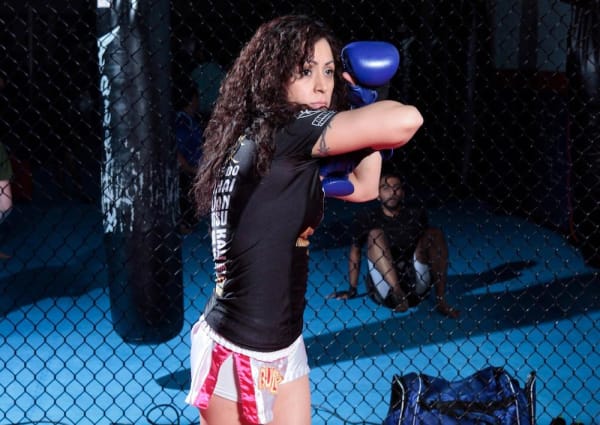
Savate also known as Boxe Française (French boxing)
or French kickboxing, is a martial art which employs both
the hands and feet as weapons and contains elements of boxing
and graceful kicking techniques using the whole foot (no shins
or knees like in Muay Thai). Savate distinguishes itself from
the 'harder' standup styles like Muay Thai by employing a
more elusive style of offence and defence.

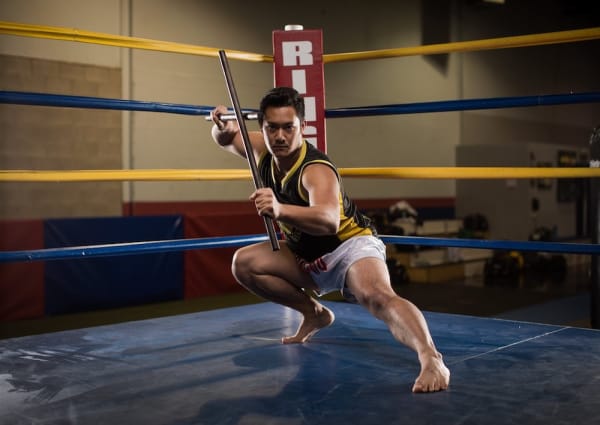
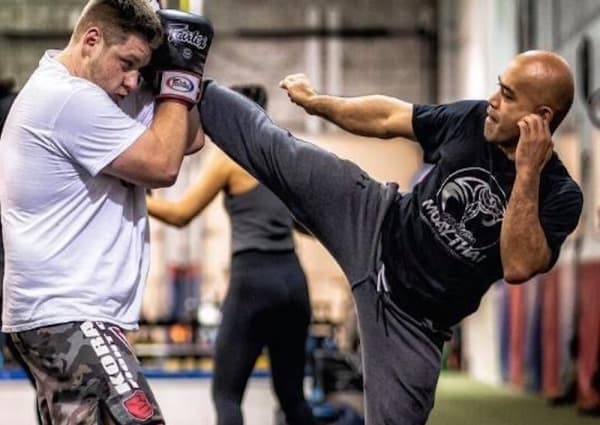
Professor Salem Assli in action - Ollie Batts©
History
The history of Boxe Francaise Savate is not totally clear,
but the following is a brief history of what is known of Boxe
Francaise Savate.
Savate was first recognized by the public in 1820 concentrated
upon the different methods and styles of foot fighting from
the various provinces of France and these were combined with
open handed defensive blows.

The creation of Savate is attributed in part to Michael Casseux.
He would spend a lot of time studying the techniques of hoodlums
and street fighters. He defined the techniques and he would
each his techniques to the rich and the noble, thus popularizing
the art. What once began as a bunch of street fighting techniques
for the hoodlums, was now a systematic way of fighting for
the rich and noble. Interest in Savate also began to spread
throughout Europe, Russia and even the United States.
Charles Lecour, Michael Casseux’s best student, dreamed
of perfecting the art of Savate. One day Lecour fought with
a well-known boxer, Owen Swift. It was at this time that Lecour
decided to include the hand techniques from English boxing,
Charles Lecour combine English boxing with French Savate.
This resulted in French boxing or Boxe Francaise Savate.
The individual most responsible for making Boxe Francaise
savate a true sport and a complete system of physical education
was Joseph Charlemont. Charlemont opened the first official
school in 1887. One of his students was Alexander Dumas, the
author of The Three Musketeers. However his two best students
were his own son, Charles and another fighter named Casteres.
In October of 1899, a contest had ensued to determine which
was better, English boxing or French Savate. This was billed
as the “fight of the century.” The French choose
Charles Charlemont and the English choose Jerry Driscoll.
The match concluded with Driscoll being KO’d by a hard
round kick to the stomach.
The 20th century began with First World Championship of Boxe
Francaise, and the victory of Charlemont over Casteres. Savate
was also included in the Olympic games in 1924 in Paris, France
as a demonstration sport.

Between the two world wars, Count Pierre Baruzy emerged as
a remarkable fighter and a “grand champion,” winning
11 French championships.
During World War II, Boxe Francaise Savate was dealt a heavy
blow, as many fighters and teachers died. However Count Baruzy
reorganized and aggressively promoted the art. If not for
the efforts of Count Baruzy, Boxc Franchise savate would cease
to exist.
It was in 1965 that the National Committee of French Boxing
was created by Bernard Plasait and Marc Kunstle. On December
12, 1965 the committee found refuge with the French Federation
of judo.

Class Format
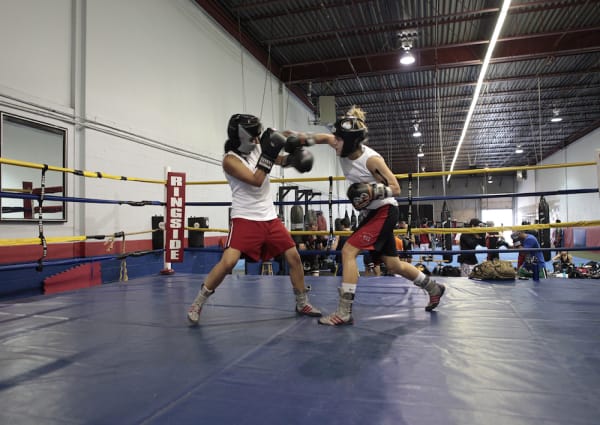
A warmup consisting of shadow boxing and bodyweight exercises
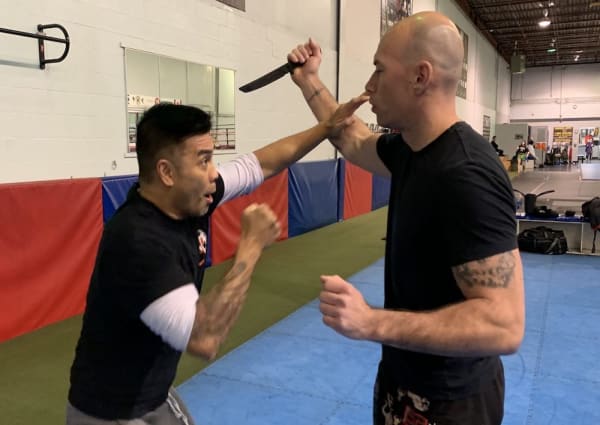
start the class. Students are then partnered to do striking
drills, using controlled contact on each other. This allows
the student to progressively develop their timing, balance,
distance, precision and defense. Sparring at the end of class
is optional under the supervision of the instructor.
Attire
Shoes are needed, preferable wrestling shoes, shorts, t-shirt, hand wraps, gloves. If sparring is involved
additional equipment such as a mouthguard are recommended.
Instructors
Dave Lanyon, Joey de Los Reyes, Calvin Millar |